
Current Spotlight
If you are interested in learning more about a project the contributor’s contact information is provided. You can also check out past articles on our main Project Spotlight page.
Introducing Algalbloomtracker.ca: Collaborative Monitoring of Harmful Algal Bloom Activity in Alberta’s Lakes in Western Canada

Algalbloomtracker.ca, an online tool that provides near real-time monitoring of harmful algal blooms for six1 Alberta lakes, in western Canada, is the result of successful collaboration and coordination amongst 12 provincial organizations2. Thanks to funding provided by Alberta Innovates and Alberta Primary and Preventative Health Services, this project exemplifies the synergy between remote sensing, lake sampling, lab work, geospatial analysis, lake stewardship, and health advisories. What began as a three-year pilot project has harnessed this wide range of expertise to support environmental reporting, public awareness, and informed decision-making, and serves as a blueprint for wider lake monitoring of harmful algal blooms.
“The Algal Bloom Tracker is an important first step towards better informing Albertans about how blue green algae are trending in popular lakes across the province.” – Dr. Rolf Vinebrooke, Principal Investigator, Ecology of Multiple Stressors Laboratory, University of Alberta
Why harmful algal blooms matter
Cyanobacteria can produce harmful toxins such as liver toxins, neurotoxins, and eventually oxygen depletion (leading to no-oxygen areas known as dead zones) when they decompose. These dead zones are harmful for other species in aquatic ecosystems.
The blooms can also have serious adverse impacts on the health of humans, pets, livestock, and wildlife, tourism and recreation industries, as well as the broader economy. Understanding when, where, and why blooms occur is critical for lake management (e.g., remediation strategies), policy decision-makers, scientists, and recreational users alike.
Harmful algal blooms in Alberta
While harmful algal blooms are a growing global concern, lake users in Alberta have observed notable increases or greater variability in average chlorophyll-a (chl-a) concentrations in recent years – chl-a is a green pigment used by cyanobacteria for photosynthesis, and is a common proxy for identifying harmful algal blooms. Warm, shallow lakes, and fertile soil coupled with the effects of climate change makes Alberta a hotspot for the growth of these toxic cyanobacteria. So far in 2026, as of September 29, Alberta Health Services has issued 39 algal bloom-related lake advisories.
The good news is that Alberta has a robust monitoring program and there is a long history of water quality sampling with the Government of Alberta, Alberta Lake Management Society (ALMS), Alberta Health Services, and Primary and Preventative Health Services taking on that role. Despite this, there are numerous challenges and sampling is limited in space and time by logistics and costs. In 2023,12 provincial partners joined forces to tackle these challenges with a pilot project to determine how satellite imagery, field sampling, and scientific analysis can help determine how blooms are changing over time. The result was the Algal Bloom Lake Monitoring Project.
The Algal Bloom Lake Monitoring Project
The project’s main objective sounds straightforward: develop replicable satellite-based models for whole-lake algal bloom characterization. However, successful implementation required careful coordination between lake sampling and the overpass of Sentinel-2 satellites. The timing needed to be within a couple hours of the satellite overpass, with ideally cloud- and wildfire smoke-free conditions during the summer and autumn months (June–October). Over the span of two years, field technicians took 20 to 30 sample sites per lake/basin at multiple intervals with water chemistry, chl-a, and phytoplankton collected at each sample location. Thanks to a dedicated team, the field campaign resulted in 1,071 samples matching with Sentinel-2 satellite overpasses through the course of the project.
Samples were then filtered and provided to Dr. Rolf Vinebrooke at the University of Alberta (U of A) for analysis to determine pigment concentrations, cell counts, and species. The U of A lab shared these results with the Alberta Biodiversity Monitoring Institute (ABMI) geospatial scientists for satellite imagery comparison using Google Earth Engine to determine if the events were successful. Scientists leveraged the unique light-reflecting properties of cyanobacteria and the spectral signatures they create. Using satellite data to measure different wavelengths of sunlight and how they interact with chl-a pigments, scientists were able to calculate the concentration of cyanobacteria in lakes.
Using the original satellite imagery researchers preprocessed each image by clipping to lake boundaries, masking out clouds, and extracting spectral signatures across multiple wavelengths at the sampled locations. They then compared the spectral signatures, captured using a calculated spectral index, with the sampled chl-a levels using statistical linear regression analysis (a mathematical equation representing the relationship between the two), and performed model calibration and validation. The final results were accurate spatial models of chl-a concentrations or harmful algal bloom activity at the pilot project lakes over the time period spanning June through October.
Results for Pigeon Lake

Introducing algalbloomtracker.ca
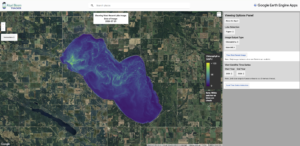
Another key project objective was to make the tracking and visualizing of harmful algal blooms publicly available. In 2026, project partners co-launched algalbloomtracker.ca, a user-friendly application that enables users to do just that, in near real time. This prototype currently reports on six of Alberta’s popular recreational lakes, each with unique characteristics and results.
The tracker features interactive mapping tools where users can view the most current bloom conditions along with historical data. Using a satellite-based model derived from field-based measurements, the tracker provides a reliable whole-lake representation of bloom conditions; showing when and how often blooms occur, as well as their location, size and how severe they are. Users can explore historical bloom patterns dating back to 2017, offering valuable insights into long-term trends and environmental change.
Bradley Peter, Executive Director of ALMS, who managed lake sampling and development of the Algal Bloom Tracker website says that the tracker represents a new way of see Alberta’s lakes and “combines field science, laboratory research, and geospatial analysis to better understand one of the province’s most challenging environmental issues.”
For the local lake groups and watershed associations involved in the project, algalbloomtracker.ca offers a centralized and accessible source of high-quality visual data to support community engagement and lake management decisions. “Visualizing a problem leads to better science and solutions for healthy lakes,” notes Bob Gibbs, director of the Pigeon Lake Watershed Association.
Project results
The three-year project has resulted in some major findings about harmful algal blooms in Alberta lakes including confirming that satellite imagery and water samples provide reliable models to track blooms. The time lapse animations reveal that each lake has unique and dynamic bloom activity, as well as confirming how rapidly lake conditions can change throughout the season. Bloom activity was shown to vary significantly from lake to lake and year to year, though lakes showing significant blooms often experienced their strongest blooms later in the season (e.g., August through October). Other lakes did not experience any detectable blooms throughout the study period.
Future monitoring of harmful algal blooms
While the prototype focuses on six lakes, the vision is to expand algalbloomtracker.ca to hundreds to thousands of lakes across Alberta—further strengthening the province’s ability to monitor, understand, and respond to harmful algal blooms.
Cynthia McClain, Geospatial Director at the ABMI, says this project is a strong first step to extend monitoring “With sustained investment in further growth and maintenance of the Algal Bloom Tracker we aim to provide up-to-date freshwater quality monitoring for lakes across Alberta.”
Recent work has focused on developing novel infrastructure and satellite-based monitoring approaches which enables more detailed, spatial and temporal tracking of bloom extent, duration, intensity and reconstruction of historic bloom conditions across more Alberta lakes. Project collaborators are currently seeking funding and partnerships to continue this work. They aim to explore the role of unique algal pigments, impact of tea-coloured lakes, reconstructing historical water quality and forecasting future water quality and blooms. By making high-quality, science-based information freely available, algalbloomtracker.ca positions Alberta as a leader in collaborative, technology-enabled freshwater monitoring.
Algal Bloom Monitoring in Alberta Lakes Overview (click graphic to view hi-res original)

Infographic of Harmful Algal Blooms in Alberta Lakes pilot project. Credit: ABMI
For more information please visit:
- Algalbloomtracker.ca
- ABMI’s Algal Bloom Monitoring project webpage
- Online webinar: Monitoring Algal Blooms in Alberta’s Lakes: Introducing the Algalbloomtracker.ca and the Science Behind It
References:
-
Pilot project lakes in Alberta: Ethel Lake, Lac La Biche, Sylvan Lake, Nakamun Lake, Pigeon Lake, and Wabamun Lake.
-
Project partners: University of Alberta, Alberta Biodiversity Monitoring Institute, Alberta Lake Management Society, Alberta Primary and Preventative Health Services, Alberta Environment and Protected Areas, Alberta Health Services, Pigeon Lake Watershed Association, Lac La Biche County, Wabamun Watershed Management Council, Associated Environmental Consultants Inc., Environment and Climate Change Canada, Alberta Innovates