Project Spotlight
The Project in the Spotlight is a feature of this webpage where we highlight a new or ongoing water quality projects of interest to the GEOAquaWatch Community. If you would like us to feature your project please contact Merrie Beth Neely
World Lake Day – August 27, 2026
This space will spotlight GEO AquaWatch member’s recent research as contributions to recognize World Lake Day, celebrated each year on August 27th. GEO AquaWatch members use aquatic remote sensing and in situ data monitoring, often in combination with modelling, to provide actionable knowledge for decisionmakers and society on lake water quality. If you are interested in learning more about a project the contributor’s contact information is provided. You can also check out past articles on our main Project Spotlight page.
AquaWatch4Lakes
Reprinted in it’s entirety with permission from CSIRO’s AquaWatch Australia Project. Photo credit CSIRO
World Lakes Day – Improving Lake Water Quality from Ground to Space
Water, in all its forms, is essential for life. Across the world, lakes provide critical resources that support ecosystems, biodiversity, local economies, agriculture, health and wellbeing, and cultural and community traditions. For millions of people, healthy lakes are fundamental to sustainable livelihoods and environmental resilience.
Yet many lakes are facing increasing pressure. Growing populations, expanding agricultural activities, overexploitation of water resources, and intensifying fishing and aquaculture practices are placing unprecedented demands on these valuable systems. As a result, water quality is deteriorating in many regions, threatening ecosystems, food security, and the communities that depend on them. Something needs to change.
The first step towards effective lake management is understanding lake health through reliable water quality monitoring. However, monitoring water quality is far from simple. A complex combination of environmental and human-driven factors influences lake condition, and decision-makers require accurate, accessible, and timely information to understand current conditions, identify emerging pressures, and evaluate potential management actions.
This is where the AquaWatch4Lakes Indonesia project is making a difference.
AquaWatch is an Australian-led initiative that aims to improve water quality monitoring and management by combining satellite Earth observation with in-situ sensor networks and advanced data analytics. In Indonesia, CSIRO is working in partnership with the Australian Department of Climate Change, Energy, the Environment and Water (DCCEEW), its counterpart in the Indonesian Ministry of National Development Planning (BAPPENAS), Indonesia’s National Research and Innovation Agency (BRIN), University of Hasanuddin and other local key stakeholders to demonstrate how innovative technologies can support better water management outcomes.
The AquaWatch4Lakes demonstration in Lake Tempe, South Sulawesi, showcases how observations from both space and the ground can be integrated to provide a more complete understanding of lake dynamics. Satellite Earth observation data provides valuable insights into seasonal changes across the lake, revealing patterns linked to weather events, aquaculture expansion, boat traffic, and the spread of problematic aquatic vegetation such as water hyacinth. Through partnerships with international Earth observation programs, AquaWatch can access decades of satellite imagery from missions such as Landsat and Sentinel. These long-term datasets enable scientists and water managers to track changes in water quality over time, identify trends, and better understand how both natural processes and management decisions influence lake health.
However, satellite data alone cannot tell the whole story. While Earth observation provides extensive spatial coverage and historical context, in-situ monitoring delivers detailed measurements of key water quality parameters directly within the lake. This ground-based information is essential for validating satellite observations and providing the finer-scale insights needed for effective management.
By combining Earth observation data with in-situ sensor networks in Lake Tempe, AquaWatch creates a powerful and comprehensive water quality monitoring system. The resulting information can support evidence-based decision-making, improve awareness of emerging risks, and help local stakeholders respond more effectively to changes in lake condition.
On this World Lakes Day, AquaWatch4Lakes Indonesia highlights the importance of bringing together science, technology, and international collaboration to protect our vital freshwater resources. By connecting observations from space with measurements collected on the ground, AquaWatch is helping transform how lakes are monitored and managed.
Healthy lakes underpin healthy communities, ecosystems, and economies. With better information and smarter tools, we can make more informed decisions today to safeguard lake water quality for future generations and contribute to the global goals of restoration, resilience, and sustainable water management.
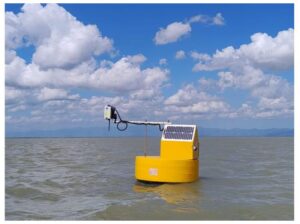
CSIRO’s in-water quality monitoring sensor kit deployed on Lake Tempe, Indonesia.
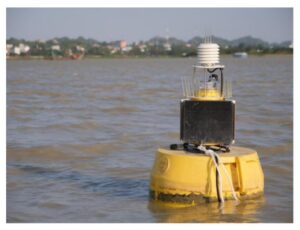
CSIRO’s Hydraspectra and in-water quality monitoring buoys (in background) deployed on Lake Tempe, Indonesia.

Maintaining the sensors in Lake Tempe, Indonesia.

Maintaining the sensors in Lake Tempe, Indonesia.
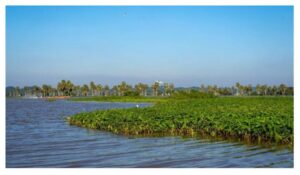
Maintaining the sensors in Lake Tempe, Indonesia.
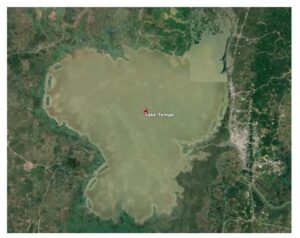
Lake Tempe, Sulawesi, Indonesia
CSIRO partnership demonstrates cutting-edge water quality monitoring in Indonesia
Sulawesi, Indonesia | 14th April 2026
CSIRO in partnership with Indonesia’s Hasanuddin University has successfully installed a new set of water quality sensors in Lake Tempe, South Sulawesi, under the AquaWatch Research Initiative. This sensor deployment marks a key milestone in an international collaboration to improve monitoring and management of Indonesia’s vital freshwater ecosystems.
The installation forms part of the AquaWatch4Lakes Indonesia Demonstrator Project, under the Australia-Indonesia Water Memorandum of Understanding. This flagship initiative demonstrates advanced water quality monitoring tools that integrate satellite Earth observation with in‑lake sensor data.
Lake Tempe is one of Indonesia’s most important inland water bodies. It supports fisheries, aquaculture, agriculture and local livelihoods. Like many lakes across the region, it faces growing pressure from sediment pollution, eutrophication, climate change and changing land use.
The newly deployed sensors provide continuous measurements of key water quality indicators, such as algal activity, turbidity and temperature. Combined with satellite data through CSIRO’s AquaWatch research initiative, the system delivers timely, reliable information to support early detection of water quality change and inform management decisions. For example, algal blooms can impact fish health and marketability, as well as the health of those households living adjacent to the lake.
“This installation brings together cutting‑edge science and on‑the‑ground capability,” said CSIRO project lead Dr Tim Malthus. “By linking satellite observations with high‑frequency in‑lake measurements, we can build a much clearer picture of how Lake Tempe is changing and provide information that supports sustainable use of the lake into the future.”
Working alongside key local project partners from Hasanuddin University’s and stakeholders in the Wajo Regency, the installation reflects the long‑standing commitment between Australia and Indonesia to work together on water resources planning and environmental management. Dr Andang Suryana Soma from Hasanuddin University’s Faculty of Forestry said “The AquaWatch4Lake initiative exemplifies UNHAS’s planetary health approach by integrating water quality monitoring at Lake Tempe as a cross-sectoral effort to preserve the environmental ecosystem, ensuring both public health and sustainable development in Indonesia.”
Beyond data collection, the initiative places a strong emphasis on capacity building and co‑design. As part of the installation visit, a workshop was held with the Wajo Regency and local stakeholders to introduce the project and identify the key water quality issues affecting Lake Tempe and the communities that depend on it. These insights are informing the selection of monitoring priorities, sensor locations and information products. Training delivered alongside the installation provides Indonesian researchers and managers with the skills needed to operate, maintain and use the monitoring system over the long term.
The Lake Tempe deployment serves as a demonstration site, with potential to scale the AquaWatch approach to other priority lakes across Indonesia, supporting national efforts to improve water quality management, climate resilience and food security.
The AquaWatch4Lakes Indonesia Demonstrator Project is led by CSIRO and funded through the Australian Government’s Department of Climate Change, Energy, the Environment and Water (DCCEEW) in collaboration with Indonesia’s National Development Planning Agency (BAPPENAS), National Research and Innovation Agency (BRIN) and Hasanuddin University.
CSIRO’s AquaWatch program aims to deliver actionable water quality information by integrating satellite data, in situ measurements and advanced analytics, helping governments and communities respond to water challenges in Australia and internationally.
See photos and find out more details in this Linked In post
Ecological condition of mountain lakes in the conterminous United States and vulnerability to human development 
Dr. Amalia Handler, Oregon State University, Invited Speaker for World Lake Day-themed Webinar on September 9, 2025.
World Lake Day Q&A with Dr. Amalia Handler, Oregon State University
World Lake Day is a great opportunity to bring researchers and lakeside communities together to co-design monitoring plans that reflect local concerns and to use scientific findings to inform local restoration and preservation efforts. This collaboration can empower communities with data about their own lakes to foster a shared sense of stewardship and action.
What are meaningful actions governments or institutions can take on World Lake Day to inspire new forms of lake monitoring and management?
Institutions can inspire new forms of monitoring by funding projects that integrate diverse data sources, from remote sensing to field samples to watershed modeling outputs. This approach can help provide a more holistic picture of lake health and assist communities in making informed management decisions.
As we celebrate the first World Lake Day, what message would you want the world to hear about your research, the lakes you studied, and your hope for those lakes’ future?
Our research on mountain lakes shows that these lakes are generally healthier than non-mountain lakes, but mountain lakes are not immune to ecological challenges. These lakes can be particularly vulnerable to pollution from even small amounts of nearby development. My hope is that this World Lake Day inspires a unified effort to protect our lakes, recognizing that safeguarding waters requires a comprehensive approach that includes everything from the surrounding basin to the lakeshores and the deepest parts of each lake.
Be sure to join us for this exciting presentation or watch the recording later on our YouTube Channel.

Satellite remote sensing to assess cyanobacterial bloom frequency across the United States at multiple spatial scales
Dr. Megan Coffer, U.S. EPA, WWQA Advisory Committee, and GEO AquaWatch Management Team

Satellite imagery was used to assess the temporal frequency of cyanobacterial blooms for over 2,000 inland, freshwater lakes and reservoirs across the contiguous United States. To quantify cyanobacteria presence, the Cyanobacteria Index was retrieved using data from the Copernicus Programme’s Sentinel-3 Ocean and Land Colour Instrument (OLCI), which offers near-daily revisit frequency at a spatial resolution of 300 m. Temporal frequency was defined for each satellite pixel as the percentage of satellite images for that pixel throughout the year exhibiting detectable cyanobacteria.
In the figure above, each state is represented as a hexagon labeled with each its two-letter state abbreviation, and each hexagon acts as a pie chart representing the proportion of pixels in the state whose annual temporal frequency indicates a cyanobacterial bloom was present. State-scale temporal frequency was highest for the states of Oregon (OR) and Ohio (OH) at 65% and 52%, respectively. Meanwhile, Georgia (GA) had the lowest state-scale temporal frequency, averaging just over 1%, and 21 states, representing nearly half of states considered, had average state-scale bloom frequencies below 10% in 2019. State-scale temporal frequency results can assist in the prioritization of sampling resources and mitigation efforts. Similar analyses have also been performed to compute the weekly occurrence of cyanobacteria and the spatial extent. Summaries of each of these indicators can be found through the U.S. EPA’s Report on the Environment “Cyanobacteria in Lakes” indicator.
Water-ForCE

After more than 3 years of work, the Water-ForCE project has come to an end in 2024. GEO AquaWatch was delighted to have Water-ForCE Scientific Coordinator Dr. Tiit Kutser, Tartu Ulikool summarize the important outcomes of this project at our 2023 Biennial GEO AquaWatch meeting.
Water-ForCE leaves a comprehensive list of 41 deliverables that are available on their website and Zenodo community, including the most important outcome: the Roadmap for the Future of inland water services for Copernicus. We encourage you to dowload and read the Roadmap for yourselves and to share the Roadmap brochure with colleagues at upcoming science meetings.
Congratulations to the entire Water-ForCE team!
Globe WQ – Global Water Quality and Analysis Platform

Globe WQ is a pilot project to create a Global Water Quality and Analysis Platform. It is the goal of the cooperative project GlobeWQ together with the United Nations Environment Programme (UNEP) to ensure that measurement data on water quality all over the world are recorded and analyzed more reliably than before by using standardized procedures. To this end, in-situ measurement data is linked with remote-sensing data and computer models. The worldwide information on water quality should be processed on a web-based platform in such a way that it can be used for decisions and measures down to the regional level.
The main goals of GlobeWQ are thus:
- to develop, test and – in exemplary ways – apply an integrated and cross-scale analysis and evaluation methodology for water quality of surface and groundwaters;
- to provide novel data synthesis of in-situ measured, modelled and remote sensing based information;
- to identify existing and developing threats to water security with focus on water quality.
GlobeWQ is embedded in the World Water Quality Alliance led by the UN Environment Programme with the challenging task to compile a World Water Quality Assessment by 2023 on current and future freshwater quality. The GlobeWQ project is a direct continuation of the pre-study that resulted in a snapshot of world’s water quality and a roadmap for a worldwide assessment. The GlobeWQ project is associated to the BMBF funding measure Water as a Global Resource (GRoW).
Find out more about the pilot on the Fact Sheet.